Data Sharing & Federation
The research problem
Cultural and creative knowledge is distributed across public institutions, collective management organisations, publishers, archives, libraries, research infrastructures, community initiatives and private platforms. These actors operate under different legal mandates, organisational structures, information systems, semantic models and professional responsibilities. Yet cultural assets increasingly move across all of them: from creation and documentation to rights administration, distribution, research, preservation and reuse.
ReactAI therefore treats federation as a multidimensional interoperability problem. The objective is not to create another central repository or require participating organisations to replace their existing systems. It is to enable independently governed organisations to exchange and reuse data, information and reviewed operational knowledge across legal, organisational, semantic and technical boundaries, while retaining their existing information systems and institutional responsibilities.
This builds on practical experience with European cultural and music data infrastructures, where interoperability cannot be reduced to successful data transfer. Information exchanged between systems must remain interpretable and usable, while its provenance, authority and conditions of use survive organisational and technical boundaries.
Data Sharing Spaces
A data sharing space provides a framework in which organisations can share and reuse data on an as-needed or as-permitted basis while retaining stewardship over their own assets. Instead of forcing participants into a single database, schema or organisational model, it creates an environment in which autonomous actors can cooperate through agreed interfaces, semantics and rules of engagement (curry_data_2020?).
This approach is particularly relevant to cultural and creative sectors, where information is distributed across organisations of very different sizes and mandates. Large platforms and institutions can maintain extensive metadata and compliance infrastructures, while smaller enterprises, archives and community organisations often cannot. Shared infrastructure can reduce duplicated work and make participation in interoperable systems possible without requiring organisational consolidation.
The Finno-Ugric Data Sharing Space (FUDSS) provides an example at community and regional scale. Its development involves archives, research groups, cultural organisations and community-curated resources operating across institutional and national boundaries. Rather than concentrating their data in a single authoritative repository, the approach combines local stewardship with shared interoperability mechanisms (antal_fudss_2025?; antal_pigozne_federico_2025?).
The same principle is applied at national and sectoral scale in the Open Music Observatory. Different implementations can follow different governance paths according to institutional capacity and existing relationships. Subsidiarity therefore does not require every participating data space to reproduce the same organisational architecture. What must be shared is sufficient interoperability for their information and services to work together.
Federation rather than centralisation
In fragmented cultural and creative sectors, federation offers an alternative to both isolated databases and a single central infrastructure. A federated architecture can reduce duplication and improve discoverability while allowing participating organisations to retain responsibility for their own information and services.
Centralisation can simplify some forms of coordination, but it also creates risks of technical fragility, governance lock-in and dependency on a single gatekeeper. These risks are particularly significant for copyright-relevant information, where errors in attribution, provenance or rights status can have direct legal and economic consequences (curry_data_2020?).
Decentralisation has its own limitations. Organisations may lack incentives to contribute, maintain incompatible practices, or retain information locally even where wider reuse would be beneficial. Effective federation must therefore make participation more attractive than isolation through lower administrative costs, improved visibility, legal clarity, shared services and reduced duplication.
The practical objective is consequently federation without forced unification. Public, private, research and community infrastructures should be able to cooperate without transferring all data to one repository, adopting one complete schema, or surrendering their institutional responsibilities.
This principle has already been tested in workflows connecting public and private cultural infrastructures. In the Open Music Observatory pilots, archival recordings identified in public collections were enriched and reconciled with authority information and subsequently transferred through commercial distribution workflows. The participating archive, metadata infrastructure, distributor and platform retained distinct roles while information moved between them. Such workflows demonstrate that federation can connect institutional systems without requiring their centralisation.
Interoperability across autonomous systems
Federation requires more than technical connectivity. ReactAI follows the multidimensional understanding of interoperability in which legal, organisational, semantic and technical interoperability must work together. Legal interoperability determines whether information can be exchanged and reused; organisational interoperability concerns mandates, responsibilities and workflows; semantic interoperability makes exchanged information mutually interpretable; and technical interoperability provides the interfaces and protocols through which exchange takes place.
In practice, this requires a combination of hard alignment and soft alignment. Hard alignment provides the minimum shared structures needed for reliable exchange, such as baseline identifiers, metadata profiles and interface requirements. Soft alignment uses mappings, crosswalks, semantic patterns and shared workflow playbooks to connect systems without requiring them to become identical.
Provenance must also survive system boundaries. When information is corrected, enriched, reviewed or transformed in one system and subsequently used by another, the receiving system should be able to determine where the information originated, what happened to it, who or what performed the relevant activity, and under whose authority. Provenance-aware workflows therefore support auditability and long-term trust while reducing the risk that information becomes detached from its evidentiary and institutional context as it moves between systems.
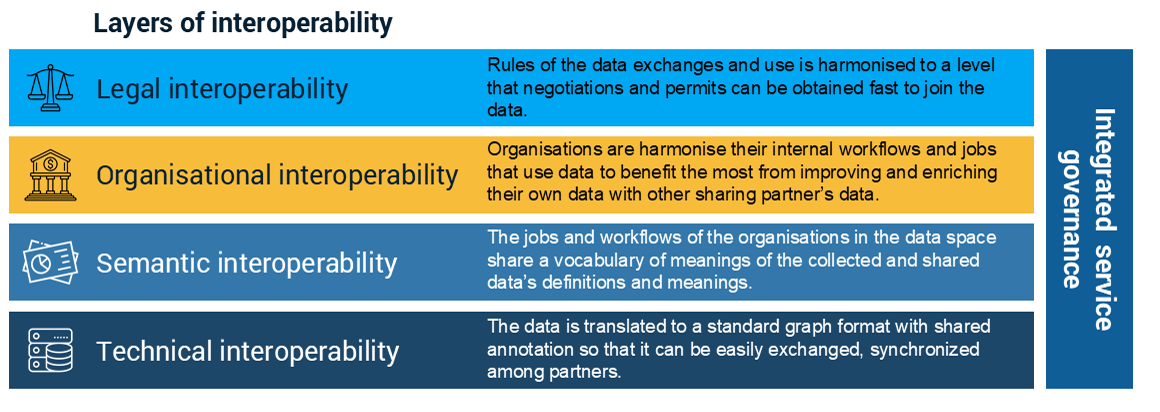
The resulting architecture does not assume that interoperability requires complete semantic alignment. Existing collection databases, rights registries, authority systems, knowledge graphs and institutional systems can remain under their existing governance while explicit mappings and shared semantic patterns establish the interoperability required for particular operations.
Bounded Federation
Bounded Federation develops this principle at the semantic level. It asks how independently governed knowledge systems can exchange useful and trustworthy assertions without requiring global ontology alignment or graph merging.
The starting point is pragmatic. Federation is established for a declared purpose rather than by attempting to reconcile everything that participating systems can technically expose. A purpose motivates a finite set of competency questions; those questions identify the semantic patterns required for the exchange; and those patterns, together with the required entity reconciliation and mappings, delimit a federation boundary.
Ontology modelling and identifier reconciliation are therefore complementary but different operations. Ontological patterns provide the conceptual structure through which comparable relationships can be expressed, while reconciliation establishes that particular identifiers refer to corresponding entities (Antal et al. 2026). Establishing that two identifiers refer to the same person, place, organisation, work or object does not imply that every assertion associated with that entity can be transferred between the participating systems.
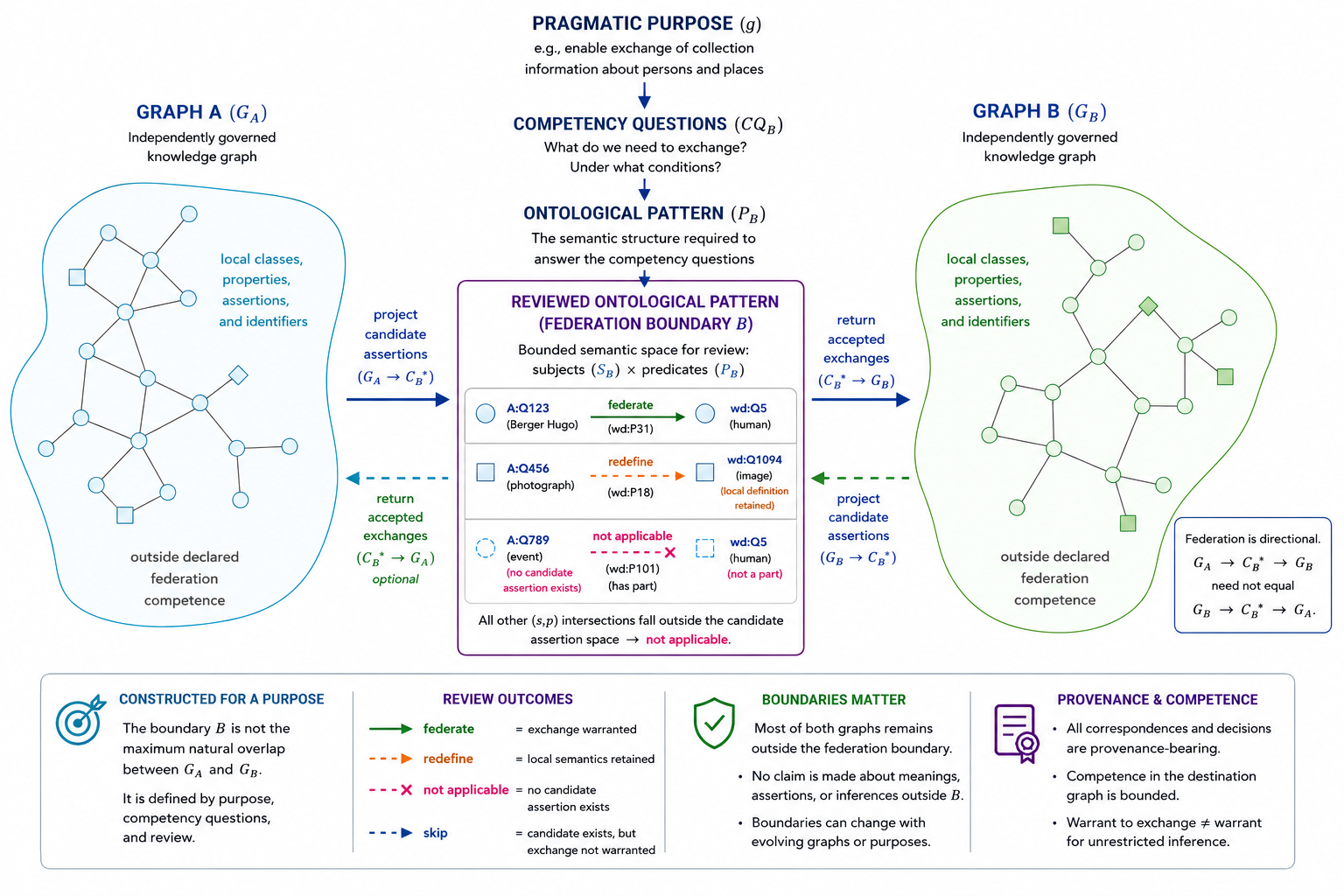
The federation boundary is semantic rather than merely technical. Within it, candidate correspondences can be accepted for federation, require local redefinition, be skipped, or be recognised as not applicable. Semantic disagreement therefore does not have to disappear before useful exchange can take place. The purpose of review is to establish which particular exchanges are warranted while allowing participating systems to retain distinctions that matter within their own domains and governance arrangements.
| Relation between the systems | Review interpretation | Federation consequence |
|---|---|---|
| Compatible assertion | Candidate can be accepted | Exchange within the declared direction |
| Different but reconcilable modelling | Candidate can be redefined locally | Local semantics are retained |
| Candidate exchange not warranted | Candidate can be skipped | No exchange |
| No meaningful atomic assertion | Not applicable | Neutral for finalisation |
| Outside the selected federation boundary | Not reviewed | No federation claim is made |
This approach is also temporally bounded. Independently governed knowledge systems continue to evolve. Their classifications, property semantics, assertions, evidence and governance may change without coordination with the systems with which they federate. A correspondence reviewed at one point in time therefore does not imply that the same correspondence remains warranted indefinitely.

Federation is consequently an ongoing knowledge-production and governance activity rather than a one-time act of ontology alignment. The relevant question is not how much of two systems can be made identical, but how much warranted exchange can be achieved for the declared purpose while preserving the distinctions that participating systems need to retain.
Research, implementation & demonstrators
ReactAI brings together research on bounded semantic federation with practical experience in building federated cultural data infrastructures. The intended European Creative Data Sharing Space is therefore not conceived as a new central cultural database. It is an interoperability environment through which European, national, sectoral and community infrastructures can exchange and reuse trustworthy operational knowledge while retaining their existing governance and technical systems.
The Open Music Observatory provides experience at sectoral and national scale, including reconciliation between public archives, rights and authority information, distributors and platforms. FUDSS extends the problem to regional and community-scale infrastructures where authority is more distributed and institutional capacity is often limited. These environments provide practical cases in which federation, subsidiarity, provenance and semantic interoperability can be tested against real institutional constraints.
Bounded Federation provides the corresponding research programme for semantic exchange. Its current demonstrators use purpose-specific semantic patterns, entity reconciliation, intermediate relational projections and human review to determine which selected assertions can cross from one independently governed knowledge system to another. The objective is mediation rather than merging: systems can reuse warranted knowledge while retaining local semantics and explicit disagreement.
- Bounded Federation: working paper on purpose-directed, reviewable semantic exchange between independently governed knowledge systems.
- Wikibase federation review: experimental graph-to-graph review workbench implemented with Betwixt.
The development objective is therefore not maximal integration. It is to make federation sufficiently precise, reviewable and interoperable for autonomous cultural and creative infrastructures to cooperate without requiring centralisation, global semantic alignment or loss of institutional responsibility.